December 27, 2025
Articles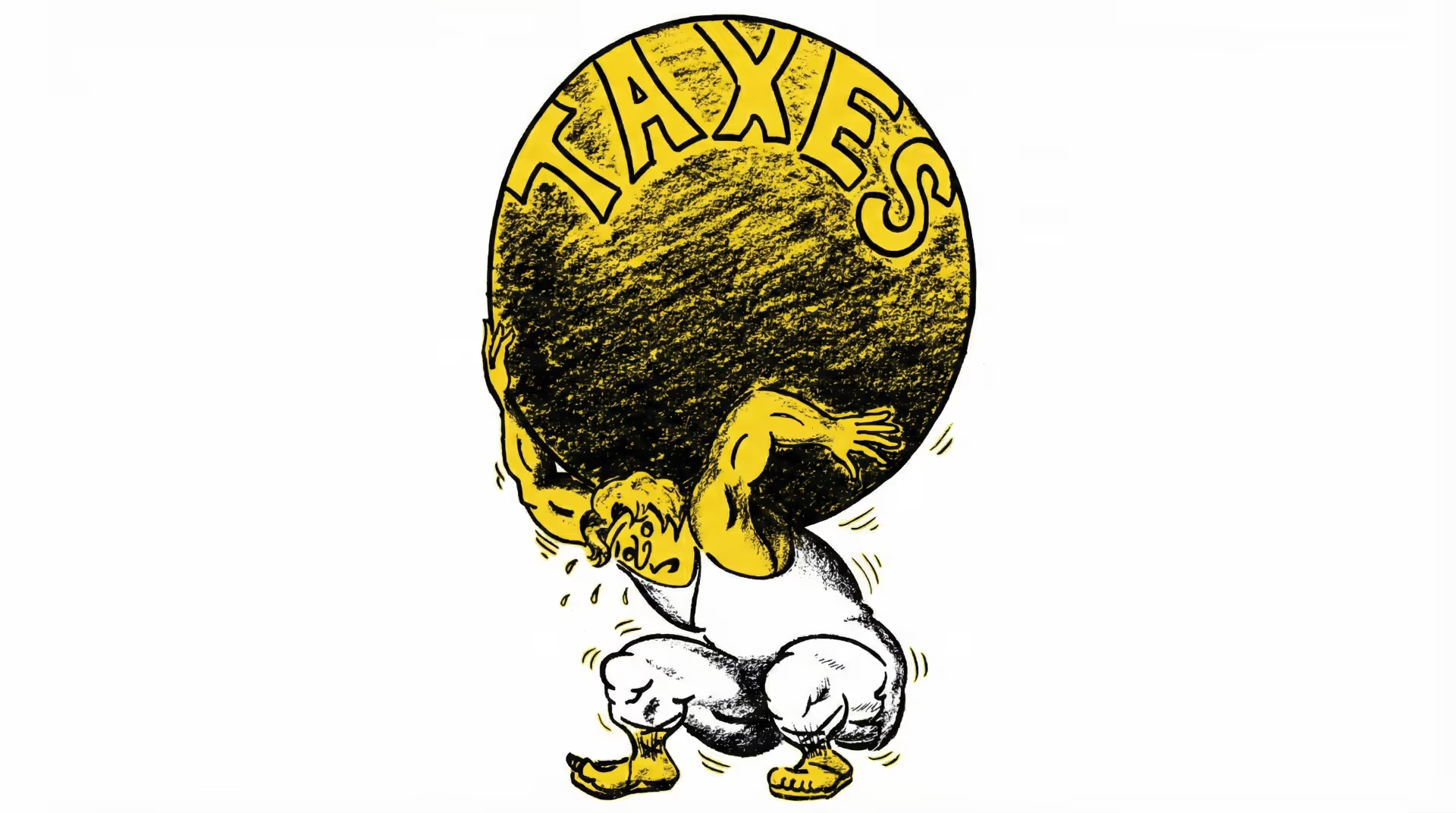
Every year, as the income tax filing season arrives, millions of Indians engage in an exercise that is both civic and deeply personal. It is civic because taxes sustain the state, fund public goods, and enable collective progress. It is personal because the act of paying tax directly shapes an individual’s financial choices, aspirations, and sense of fairness. For a growing number of Indians in the formal economy, income tax filing has become less about contribution and more about calculation, endurance, and compromise. The issue is no longer whether taxes should be paid, but whether the structure through which they are collected aligns with economic logic, equity, and long-term growth.
India’s income tax system today reflects a deeper structural tension. It seeks to raise resources from a rapidly expanding economy, yet relies heavily on a narrow and highly visible group of compliant taxpayers. This imbalance creates a compounding burden that extends far beyond income tax itself, touching consumption, savings, investment, and even life decisions such as where to work or build a business. What emerges is not just a fiscal concern, but a policy design problem that deserves serious reconsideration.
Income Tax in India: High Marginal Burden, Narrow Base
From an economic standpoint, one of the defining features of India’s personal income tax regime is the contrast between high marginal rates and a narrow effective base. A relatively small share of the population contributes the bulk of direct tax revenues, with salaried professionals and formal-sector entrepreneurs bearing a disproportionate share due to the transparency and traceability of their incomes. For this group, income tax is not a choice but a certainty, often deducted at source long before the income reaches their bank accounts.
Marginal tax rates escalate quickly, reaching 30 percent at income levels that increasingly represent upper-middle-class earnings rather than extreme wealth. When surcharge and cess are added, the effective tax rate for many individuals approaches or crosses 35 percent. In economic terms, such rates would be more defensible if they were accompanied by robust social security systems, comprehensive healthcare coverage, or strong unemployment protection. In India’s case, most taxpayers continue to privately fund education, healthcare, housing, and retirement, even after paying high income taxes.
This creates a classic incentive distortion. As marginal tax rates rise sharply within a narrow band of income, the motivation to earn, declare, and formalise additional income weakens. Economic theory and global evidence suggest that beyond a certain threshold, higher marginal rates do not proportionately increase revenue. Instead, they encourage avoidance, fragmentation of income, and behavioural shifts that reduce long-term efficiency. When compliance feels punitive rather than participatory, the system begins to undermine its own objectives.
The Hidden Tax Wedge: Indirect Taxes and Consumption
Income tax, however, represents only the first layer of taxation in an individual’s economic life. Once income is taxed at source, nearly every act of spending triggers another round of levies through indirect taxes. Goods and services attract GST at varying rates, while fuel, electricity, and several essential services remain subject to a complex mix of central and state taxes that sit outside the GST framework.
From an economic perspective, this creates a substantial tax wedge between what individuals earn and what they can actually consume or save. Post-tax income, often perceived as disposable, is in reality income awaiting further taxation. Fuel taxation is particularly significant, as it cascades across the economy by raising transportation costs, increasing prices along supply chains, and inflating household expenses. Because fuel taxes are largely uniform, they act as a regressive burden, affecting households irrespective of income levels.
Excessive indirect taxation has broader macroeconomic consequences. By compressing real disposable income, it dampens consumption, particularly discretionary spending that drives demand in urban and semi-urban economies. Over time, this can slow growth, reduce business confidence, and weaken the very tax base the system seeks to protect. When individuals feel squeezed from both ends, earning and spending, economic optimism gradually gives way to caution.
The Cost of Complexity: Compliance as an Economic Drag
Beyond the question of how much tax is paid lies an equally important question of how difficult it is to comply. India’s tax system imposes significant complexity costs on individuals and businesses alike. Multiple slabs, exemptions, deductions, frequent amendments, reconciliation requirements, and compliance notices transform tax filing into a continuous process rather than an annual obligation.
Economically, this complexity represents a misallocation of resources. Time, money, and cognitive effort that could be directed towards productive activity are instead spent on navigating rules, hiring professionals, and managing uncertainty. For individuals, this translates into anxiety and dependence on intermediaries. For small businesses and startups, it becomes a barrier to formalisation and growth, discouraging expansion beyond a certain scale.
Complexity also distorts incentives. When rules are opaque and frequently changing, compliance shifts from being a straightforward civic duty to a strategic exercise. This encourages aggressive tax planning over genuine value creation, reducing overall economic efficiency. In such an environment, simplicity itself becomes a form of economic reform.
Capital, Talent, and the Mobility Question
One of the most understated consequences of India’s current tax architecture is its impact on capital and talent mobility. In an increasingly interconnected world, high-skilled professionals, entrepreneurs, and investors operate in a global marketplace for opportunity. They compare not only tax rates, but also predictability, ease of compliance, quality of public services, and the overall respect accorded to taxpayers.
When post-tax incomes feel disproportionately constrained and compliance processes feel adversarial, individuals and firms begin to reassess their options. This does not always manifest as immediate migration, but it influences decisions on where to incorporate, where to invest, and where to scale. Over time, these micro-decisions aggregate into macroeconomic outcomes that affect innovation, job creation, and competitiveness.
From an economic lens, this is not a moral failing but a rational response to incentives. A tax system that inadvertently encourages capital and talent to seek more predictable environments risks eroding its long-term growth potential.
Why This Is a Policy Design Issue, Not a Moral One
It is crucial to frame this discussion carefully. Taxes are indispensable to nation-building, particularly in a country with India’s developmental ambitions. The issue at hand is not resistance to taxation, but concern over design. A well-designed tax system balances revenue needs with economic efficiency and social legitimacy.
When the burden of taxation falls repeatedly on the same compliant group, and when the same income is taxed at multiple stages, the system risks weakening the social contract that underpins voluntary compliance. Over time, resentment replaces trust, and enforcement begins to substitute for cooperation. This is not a sustainable foundation for fiscal policy.
Expanding the Solution Space: What Rethinking Could Look Like
A serious rethinking of India’s personal tax framework requires moving beyond incremental adjustments towards structural reform. Broadening the tax base through simplified compliance and predictable rules can distribute the burden more evenly without deepening pressure on existing taxpayers. Rationalising marginal rates and reducing the number of slabs can improve declaration incentives while maintaining revenue neutrality.
Equally important is addressing multiple taxation by integrating direct and indirect tax policies more coherently, particularly on essential goods and services. Simplification, stability, and clarity should be treated as economic objectives, not administrative conveniences. A system that is easier to understand and comply with naturally encourages participation.
Perhaps most importantly, the narrative around taxation must evolve. When honest taxpayers are treated as partners in nation-building rather than suspects under constant scrutiny, trust deepens and compliance becomes self-reinforcing.
The Larger Economic Payoff
The benefits of such reform extend far beyond individual relief. A fairer and simpler tax system strengthens consumption, encourages savings, supports entrepreneurship, and enhances India’s attractiveness as a destination for talent and capital. Over time, it creates a virtuous cycle in which growth expands the tax base organically, reducing the need for punitive rates.
The Question That Remains
India stands at a pivotal moment in its economic journey. Growth ambitions are high, aspirations are rising, and global opportunities are expanding. Yet, the sustainability of this growth depends on whether citizens believe the system they contribute to is fair and forward-looking.
The honest taxpayer’s dilemma is not a complaint. It is a signal. Listening to it, and responding with thoughtful reform, may be one of the most important economic choices India makes in the years ahead.
(The opinions expressed in this article are solely my own and do not reflect the views of my employer or any affiliated organization.)