
November 3, 2025
Articles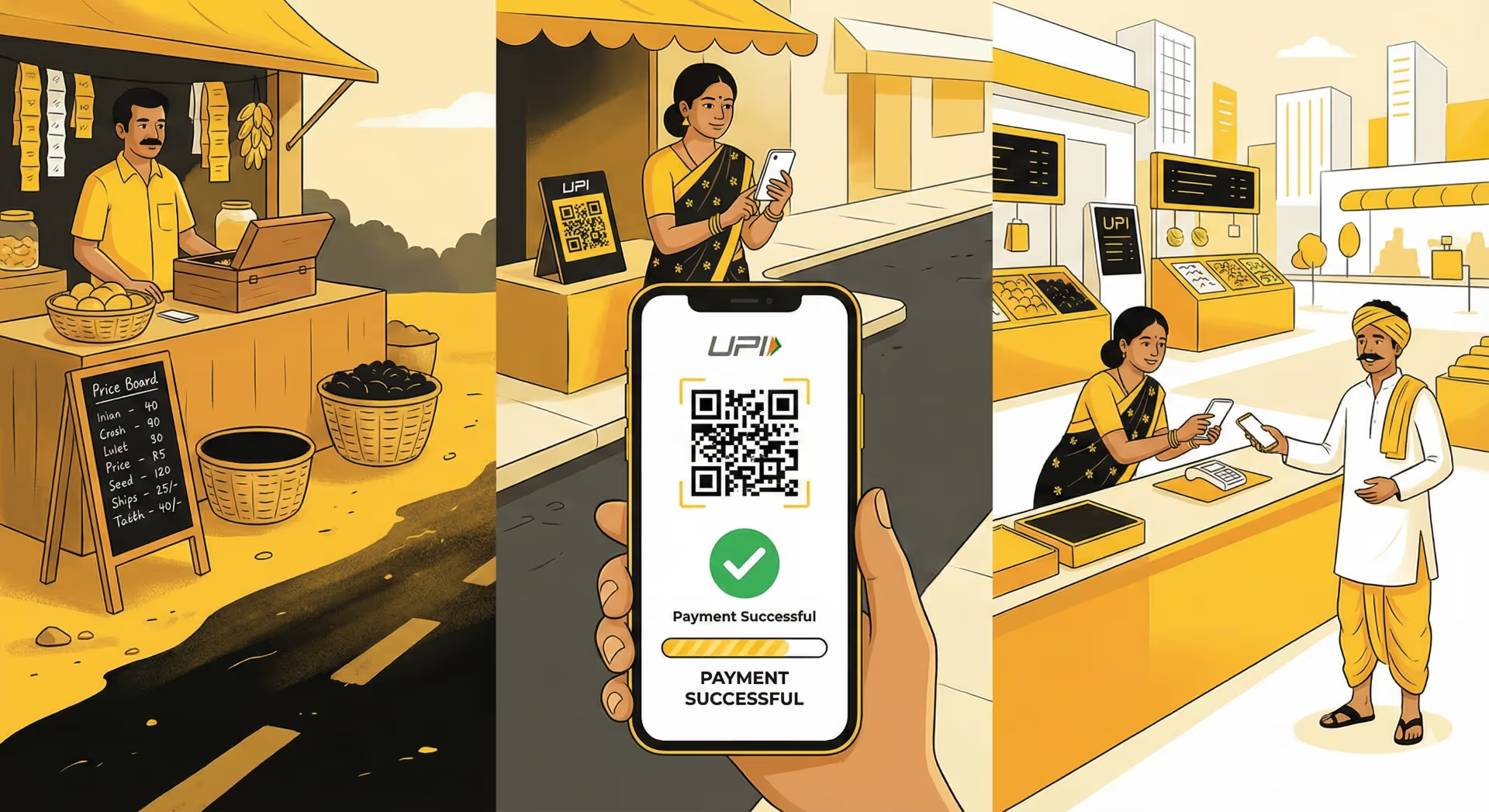
Every once in a while, a country builds something so simple in idea yet so profound in impact that it quietly shifts the course of its economy, its policy narrative, and even its global standing. For India, that something is the Unified Payments Interface, or UPI. In less than a decade, this open digital payments protocol has gone from a domestic innovation to a platform that now processes over 13 billion transactions a month, or roughly 430 million a day, representing more than 80 percent of India’s retail digital payments. The sheer scale of it is staggering. India now accounts for nearly 46 percent of all real-time digital payments in the world. But beyond the numbers lies a deeper story of design, intent, and leadership.
When UPI was launched in 2016, the vision was deceptively simple: make money move between bank accounts as easily as sending a message. But what followed was not just a technological leap, it was a policy one. UPI was built not as a private product chasing profit, but as digital public infrastructure, open, interoperable, and universally accessible. It was India’s decision to treat payments as a public good rather than a private privilege. Today, over 70 crore bank accounts, 65 million merchants, and hundreds of fintech platforms are connected through a common interface. Every QR code at a tea stall, every tap at a retail store, and every transfer between friends are part of one national network. Few nations have achieved that level of digital universality.
In most parts of the world, payments infrastructure evolved as a commercial layer sitting atop banks. India reversed that logic. It built a shared public platform first and invited innovation to flourish around it. That single design choice unlocked one of the most competitive yet cooperative digital ecosystems anywhere in the world. Players like PhonePe, Google Pay, Paytm, and newer entrants compete fiercely for users, yet coexist seamlessly on the same rails. It is a rare case of market dynamism enabled by public design, a harmony of policy and innovation that few countries have managed to sustain at scale.
Perhaps UPI’s most understated achievement, though, is behavioural. It changed how India thinks about money, trust, and informality. Millions of users who once relied only on cash now transact digitally, not because they were told to, but because they saw that the system worked. UPI built trust not through persuasion, but through performance. Every successful transaction reinforced confidence in institutions, in technology, and in the very idea of inclusion. This is policy as behavioural reform, and it happened at population scale. What began as a tool for convenience has evolved into a cultural transformation, where digital trust is now embedded in everyday life.
What makes UPI extraordinary is how it has moved from being a domestic solution to becoming a global idea. Increasingly, UPI is India’s most visible digital export. It is already live or being integrated in Singapore, France, the UAE, Mauritius, Bhutan, Nepal, and Sri Lanka, with discussions under way in Japan and Indonesia. These are not just convenience tie-ups; they represent a shift in how digital cooperation is imagined. Each such partnership carries the quiet weight of trust and technological confidence. As Nikhil Kamath recently noted in a thought-provoking post, UPI’s expansion is not merely about financial connectivity. It is a demonstration of geopolitical influence built through code. If oil pipelines shaped power in the twentieth century, payment pipelines may well define the twenty-first.
In this global push, one cannot overlook the leadership element that set the tone for India’s digital ambition. The Prime Minister Modi’s emphasis on building India’s digital public infrastructure as a foundation for global inclusion has been instrumental in giving UPI both political direction and international visibility. Initiatives such as the India Stack diplomacy, showcased prominently during the G20 Presidency, have turned domestic success stories like UPI into instruments of India’s soft power. The effort to integrate UPI with platforms abroad is no longer just a fintech experiment. It is part of a larger economic and diplomatic narrative where India positions itself as a provider of trusted, inclusive digital solutions to the world. The policy vision behind it, of using technology to empower and not exclude, has helped UPI evolve from an Indian innovation into a global benchmark.
UPI’s deeper impact also lies in what it is quietly creating beneath the surface - data equity. For decades, financial credibility was a privilege, often limited to those already inside the formal economy. UPI changed that. Every digital transaction leaves behind a trail of trust, a verified history of credibility for individuals and small businesses who never had one before. For the first time, transactional data is becoming a currency of credibility. UPI is turning participation itself into capital, giving small entrepreneurs the digital footprints they need to access credit and grow. This is not just inclusion in numbers; it is inclusion in evidence.
At the heart of UPI’s success is trust, something that cannot be legislated but must be earned. The system processes billions of transactions with an uptime and reliability rate that rivals the best in the world. For users, the experience is instantaneous; for policymakers, it is proof that scale and inclusion can coexist. What began as a convenience has become a behavioural shift. For millions of first-time digital users, UPI was their introduction to formal finance. Today, it is also their identity within it. Each scan or transfer builds data that in turn enables access to credit, insurance, and savings, essentially digitizing financial dignity.
The ripple effects on the economy are immense. Small businesses now account for nearly 40 percent of UPI’s merchant transactions, many of whom had never been formally digitized before. Credit scoring models built on transaction data are enabling nano-loans in seconds. Micro-entrepreneurs are discovering new markets through QR codes. In this way, UPI has quietly done what few government programs could. It has turned digital inclusion into economic participation.
Yet perhaps the most fascinating dimension of UPI is what it represents for governance itself. Traditionally, policy has been about rules and institutions. With UPI, India has shown that protocols can govern too. When the rules of inclusion, transparency, and access are built into the design of a system, governance begins to operate through code. This is a quiet but radical reimagining of how states can enable trust, not by decree, but by architecture. UPI, in that sense, is not just a payments system; it is a new model of governance, where public purpose is enforced not by regulation alone but by design.
As India takes UPI to the world, new questions will emerge around governance, monetization, and sovereignty. Who owns the rails when they cross borders? How do you sustain free transactions while ensuring commercial viability for ecosystem players? How do you balance openness with security? These are complex challenges, but they are also signs of leadership in uncharted terrain. For a nation that once imported most of its technology frameworks, to now be exporting one of its own is a remarkable reversal of narrative. India is no longer just a participant in the digital economy. It is a standard-setter.
UPI’s story, then, is not just about payments; it is about policy imagination. It is about a government choosing to lead through design, a private sector that chose to build within that design, and a citizenry that adopted it at breathtaking speed. It is about the alignment of purpose, policy, and possibility. The fact that UPI now moves more value daily than Visa and Mastercard combined in India is symbolic, yes, but it is also instructive. It tells us that when the public and private sectors collaborate with intent, scale becomes a byproduct of trust, not of marketing.
And perhaps, that is the quietest yet most profound legacy of UPI. It has turned a government initiative into a global model, a financial tool into an instrument of diplomacy, and an idea into influence. It shows that the future of innovation may not lie in disruption alone, but in designing systems that include, empower, and endure.
(The opinions expressed in this article are solely my own and do not reflect the views of my employer or any affiliated organization.)