November 10, 2025
Articles
For most public policy professionals, bureaucracy is an everyday reality. We work with government systems, engage with departments, and interact with officers who move files, draft notes, and make decisions that shape the course of policy. Yet, for many, bureaucracy often feels like a world apart, slow, procedural, and rule bound. Over the years, my perspective on this has changed entirely.
Much of what I share here comes from my firsthand experience of spending time with bureaucrats, not just in my day-to-day professional interactions, but also from a much earlier phase of life. When I was studying at the London School of Economics, I had senior bureaucrats from the Indian government as classmates. They were pursuing the same course, and I was constantly in awe of the clarity, composure, and intellect they brought to every discussion. In those early days, as I was still settling into a new academic and cultural environment, many of them became a source of insight and calm. They had a remarkable ability to distill complexity into simple, structured thoughts, a skill I only later realized was the product of years of working within systems where order and precision matter deeply.
After I returned from London and began working with the government, I had the opportunity to report directly to bureaucrats. Those experiences were among the most enriching of my professional journey. Watching them up close changed my understanding of what discipline and composure truly mean. Their days were long, their responsibilities immense, yet their decision-making always came from a place of balance. They worked within systems that demanded accountability at every level, yet their approach to challenges was almost always measured and thoughtful.
Of course, bureaucracy is not without its critics. Many see it as slow, risk-averse, and bound by procedure. There are moments when processes appear to stifle creativity or delay action. I have felt this frustration myself, especially when a promising idea seemed to get lost in a chain of approvals or when urgency met hesitation. Yet, over time, I have come to see that what looks like rigidity from the outside often has a deeper purpose, to protect fairness, to ensure accountability, and to prevent errors that could have far-reaching consequences. What might feel like resistance is often a reflection of responsibility.
As public policy professionals, we often learn the most not from what works smoothly, but from what feels difficult. Working with bureaucracy teaches us patience, adaptability, and the art of influence, how to move ideas through structures designed to test them. These lessons are invaluable because policymaking is not about quick wins but about building durable outcomes that last beyond political cycles and personnel changes.
Over the years, I have also interacted with bureaucrats across state governments, officers who, to me, represent some of the most intelligent and grounded individuals I have ever met. Their intelligence is not only academic or analytical; it is deeply situational. They know how to manage uncertainty, navigate constraints, and get things done in environments that are often politically charged and resource constrained. These are not just officials; they are problem-solvers who understand how to balance ambition with realism.
There were also phases in my own professional life when I felt completely lost, especially in the early years of transitioning to the corporate world. The pace, the expectations, and the culture were very different. During those moments of confusion, I often found myself reaching out to the same bureaucrats I had worked with earlier. Their advice was always calm, considered, and rooted in a kind of wisdom that only comes from navigating complex systems. Many of them helped me think more structurally, to see patterns where I saw chaos, and to separate urgency from importance. In many ways, they shaped how I think, how I work, and how I approach decision-making today.
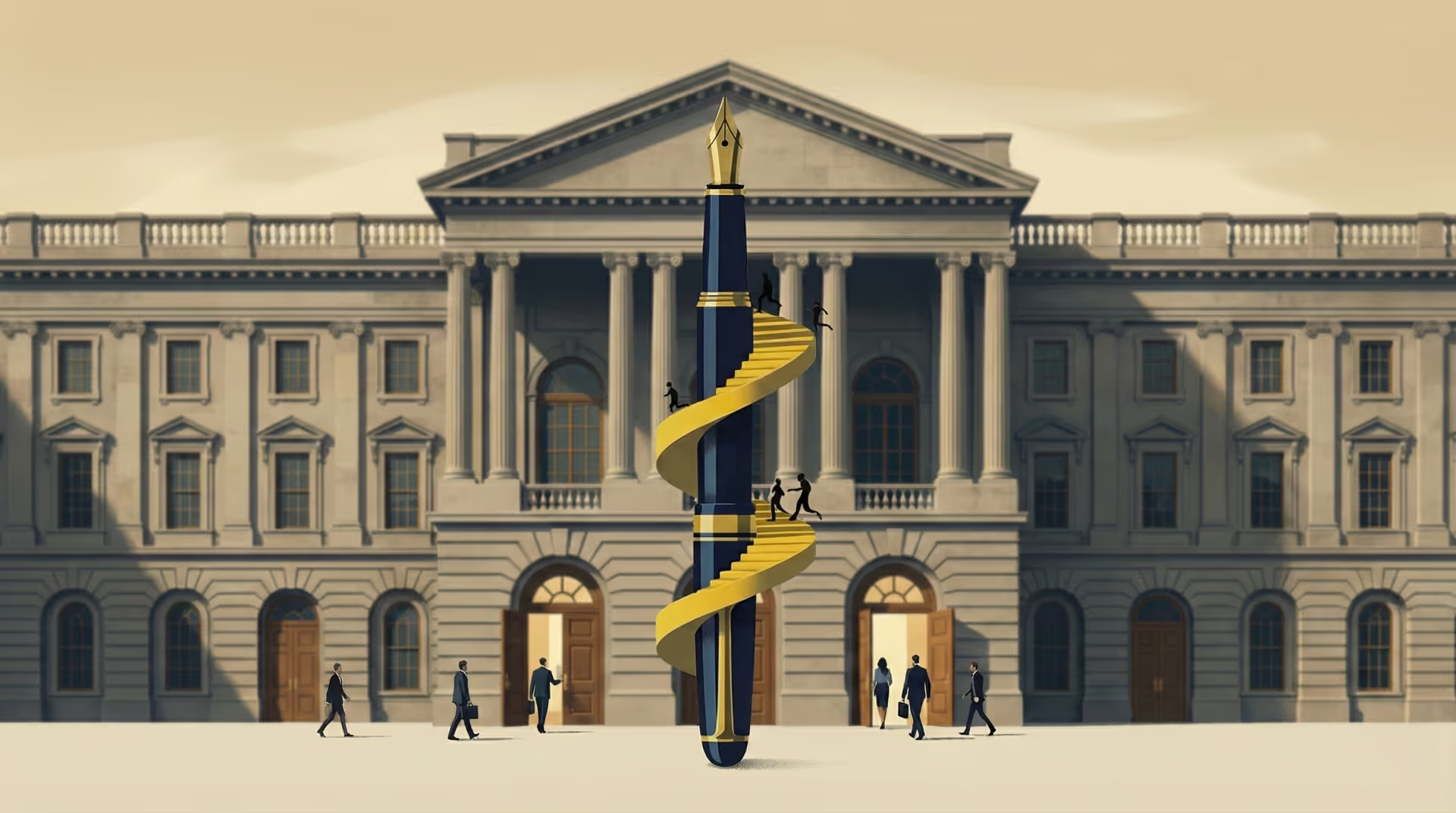
What makes bureaucrats truly remarkable is not just their intellect but their ability to sustain continuity, uphold fairness, and keep institutions functioning regardless of who sits in power. They remind us that process is not the enemy of progress. It is the foundation that keeps progress consistent. For public policy professionals, this is a critical lesson. We may be trained to think fast, innovate, and influence, but bureaucracy teaches us something deeper, discipline, respect for process, and the value of continuity.
Learning from bureaucrats is not about emulating them blindly. It is about understanding the design of governance and appreciating the thoughtfulness that sits beneath every layer of procedure. It is about recognizing that systems exist to ensure stability and that real impact often comes from working within those systems, not around them.
For me, these experiences have left a lasting mark. They have made me more patient, more grounded, and more strategic in how I approach public policy work. When I look back, some of my most meaningful professional lessons did not come from classrooms or boardrooms but from conversations with bureaucrats who had mastered the art of balance, between ambition and caution, speed and stability, ideas and implementation.
In a world that celebrates disruption, we often forget the value of continuity. Bureaucrats embody that continuity. And for public policy professionals, learning from them might just be one of the most transformative forms of growth there is.
(The opinions expressed in this article are solely my own and do not reflect the views of my employer or any affiliated organization.)